

Peptide Stacking in Research: Why Combinations, and Which Ones the Literature Actually Supports
Peptide Stacking in Research: Why Combinations, and Which Ones the Literature Actually Supports
‘Stack’ is the community term for combining two or more research peptides in a single protocol. Peptide stacking appears everywhere in the literature — but not all stacks have research backing. Below is what peptide stacking actually supports, what remains experimental, and how to think about combinations in research design.
Why combinations make pharmacological sense
First, most research peptides act through a single mechanism. Tissue repair, GH release, immune modulation — each is a multi-step biological process with multiple intervention points.
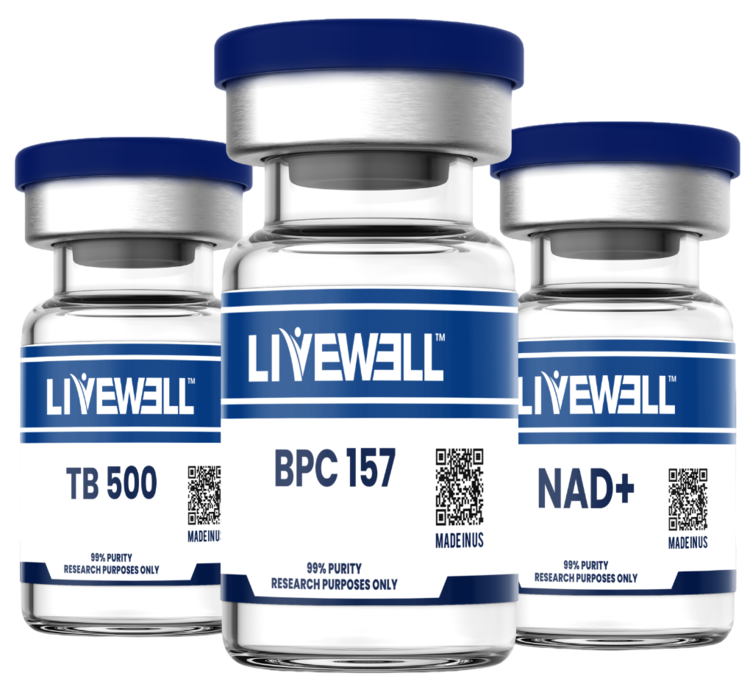
Therefore, combinations target multiple steps simultaneously. The BPC-157 + TB-500 Blend (BPC-157 + TB-500) is the canonical example: BPC-157 sends the repair signal; TB-500 mobilizes the cells that respond to it.
Stacks with strong literature support
BPC-157 + TB-500 Blend (BPC-157 + TB-500) — most-cited two-peptide combination in connective-tissue repair literature.
GHRH + GHRP — the classic synergy. Most-cited specific combinations: CJC-1295 No DAC + Ipamorelin, Tesamorelin + Ipamorelin.
KLOW-style four-component blends (BPC-157 + GHK-Cu + TB-500 + KPV) — less individual literature on the four-way combination but each component is well-studied individually.
Stacks that are speculative
However, many community-coined stacks lack published combination research. The individual components may be well-studied, whereas the specific combination often is not. Researchers should distinguish between ‘stack supported by combination literature’ and ‘individual peptides used together.’
Combinations across mechanism classes (e.g., GLP-1 + tissue-repair peptide) may have rationale but typically have less direct research support.
Practical considerations for combination research
Pre-blended vials (BPC-157 + TB-500 Blend, KLOW, Tesa+Ipa, CJC+Ipa blends) simplify protocols.
Dose attribution: in combination studies, separating the effect of each component from the effect of the combination remains a known design challenge. Single-arm comparisons need parallel single-compound controls.
How to evaluate a peptide stacking claim
Ask three questions before accepting any stack. First, does published work test the combination itself, or only the individual compounds? Second, do the mechanisms actually complement each other, or do they simply overlap? Third, can the study design attribute an effect to one component rather than the pair?
Because most peptide stacking claims circulate through forums rather than journals, the answer to the first question is usually no. That does not make a combination worthless. Instead, it means researchers should treat it as a hypothesis and build controls accordingly.
Related at LiveWell
BPC-157 + TB-500 Blend · KLOW blend · CJC-1295 + Ipa · Tesa + Ipa · Live Extreme bundle
Frequently asked questions
What is a peptide ‘stack’ in research?
‘Stack’ is community terminology for combining two or more research peptides in a single protocol. The BPC-157 + TB-500 Blend (BPC-157 + TB-500) is the most-cited example.
Which peptide stacks have the strongest literature support?
Three: the BPC-157 + TB-500 Blend (BPC-157 + TB-500), the classic GHRH + GHRP synergy (CJC-1295 No DAC + Ipamorelin or Tesa + Ipa), and the four-component KLOW-style blends. Other stacks are more speculative.
Why use a pre-blended vial vs separate vials?
Mainly convenience and consistency. By contrast, separate vials let researchers vary dose ratios independently.
Does peptide stacking always work better than a single peptide?
No. Combination research support varies enormously by pairing. Moreover, adding compounds adds variables, which makes results harder to interpret rather than easier.
What controls does a peptide stacking study need?
At minimum, parallel single-compound arms plus a vehicle control. Otherwise, any observed effect cannot be attributed to the combination itself.
Are pre-blended vials as flexible as separate vials?
No. Pre-blended vials fix the ratio, which improves consistency but removes the ability to vary dose ratios. Consequently, dose-ranging work usually needs separate vials.
For laboratory and research use only. LiveWell Peptides products are not intended for human consumption, injection, topical application, or any other administration to the human body. This article is informational and not medical advice.