

GHK-Cu and Skin: The Copper Peptide Research Behind the Glow Protocol
GHK-Cu and Skin: The Copper Peptide Research Behind the Glow Protocol
GHK-Cu is a copper-binding tripeptide (Gly-His-Lys + Cu²⁺) that occurs naturally in human plasma. Moreover, since its discovery in 1973 it has accumulated decades of peer-reviewed literature — and the recent surge of interest in ‘copper peptides’ for skin rests on a real, if often oversimplified, scientific base.
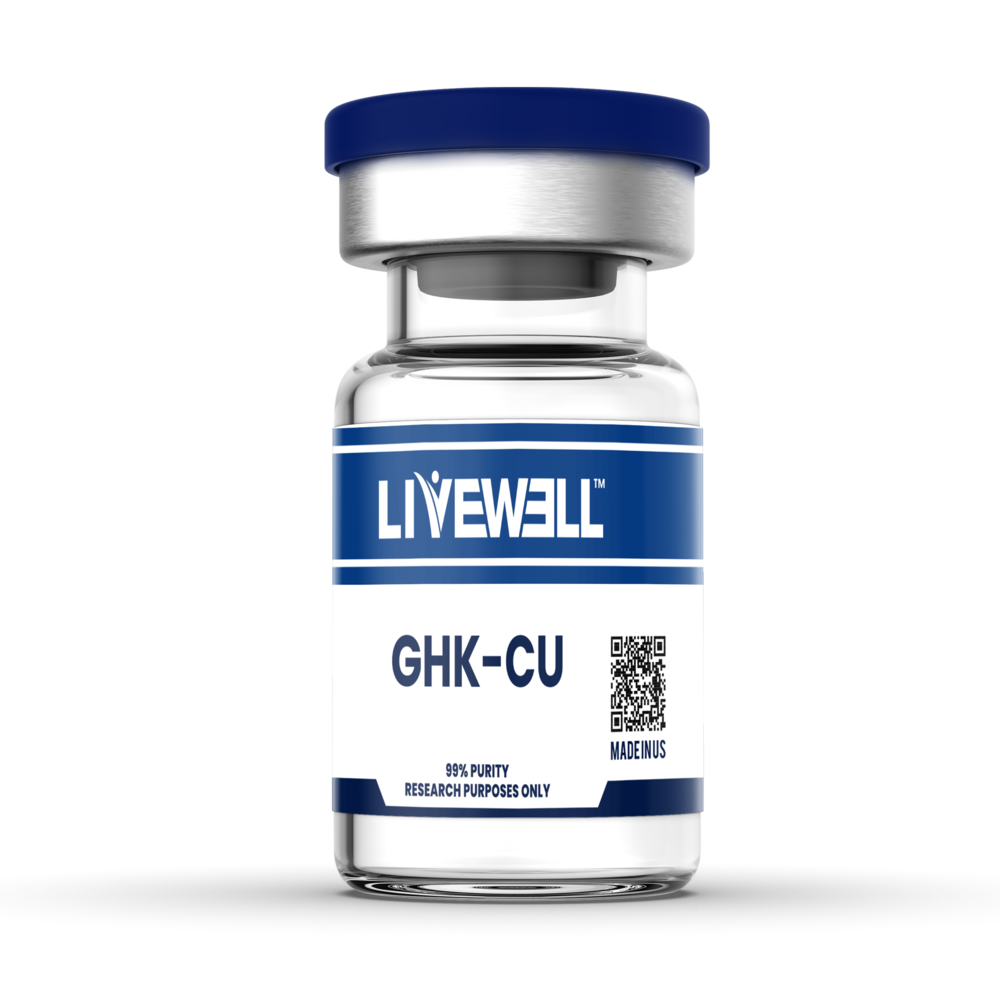
What GHK-Cu actually is
First, GHK is a tripeptide of glycine, histidine, and lysine. Specifically, the functional form binds Cu²⁺ — copper ions — in a 1:1 complex. That’s the GHK-Cu studied in skin research.
Notably, plasma levels decline significantly with age — by some estimates more than 60% by middle adulthood. Consequently, that decline is part of why laboratories study the tripeptide in aging skin contexts.
The skin research
Researchers study it for collagen and elastin synthesis modulation, dermal antioxidant activity, wound-healing acceleration in topical models, and modulation of inflammatory signaling in skin.
Topical application remains the most-cited route in dermatology research.
The Glow Protocol context
The community-coined ‘Glow Protocol’ refers to combinations of GHK-Cu with other peptides (BPC-157, TB-500, KPV) studied for combined skin and connective-tissue effects. LiveWell’s KLOW blend captures the most-common four-component version.
Therefore, for research focused specifically on skin remodeling, GHK-Cu alone remains the single best-studied compound — the multi-peptide stacks add mechanism breadth at the cost of variable interpretation.
In addition, keep lyophilized vials at -20°C for long-term storage. Avoid repeated freeze-thaw cycles.
What the skin literature actually examines
Published dermatology work clusters around four themes. First, investigators track collagen and elastin synthesis in cultured fibroblasts and in topical models. Second, they measure antioxidant activity in dermal tissue. Third, they follow wound closure rates and remodeling quality. Finally, they look at inflammatory signaling, because inflammation shapes how skin repairs itself.
Importantly, most of this work sits in cell culture and animal models rather than large human trials. Therefore, researchers should read the literature as mechanism-building rather than proof of a cosmetic outcome. In addition, formulation matters enormously: concentration, vehicle, pH, and copper ratio all change what a study measures.
Practical handling notes for laboratories
Because the complex depends on an intact copper bond, handling matters. Moreover, repeated freeze-thaw cycles degrade peptide integrity, so aliquoting into single-use portions is standard practice for longer studies.
Every vial should also arrive with a current certificate of analysis from an independent third-party laboratory. Otherwise, purity and identity remain unverified, and any downstream result becomes difficult to interpret.
Related at LiveWell
Copper peptide vials · KLOW blend · Peptide glossary
Frequently asked questions
What is the Glow Protocol?
‘Glow Protocol’ is a community term for research combining GHK-Cu with complementary peptides (often BPC-157, TB-500, KPV) for combined skin and tissue research. LiveWell’s KLOW blend is one common four-component formulation.
Again, the color comes from the copper binding.
Can researchers combine GHK-Cu with other peptides for skin research?
Yes. For example, research has examined the copper peptide alongside BPC-157, TB-500, and KPV. Each addresses a different limb of skin biology. LiveWell’s KLOW blend is one common combination.
What is GHK-Cu in simple terms?
It is a copper-binding tripeptide made of glycine, histidine, and lysine that occurs naturally in human plasma. Because scientists first described it in 1973, it carries an unusually long research record for a peptide.
Why do declining plasma levels matter?
Plasma concentrations fall significantly with age, by some estimates more than 60% by middle adulthood. As a result, aging-skin research often uses that decline as its starting hypothesis.
Which administration route do skin studies use most?
Topical application dominates the dermatology literature. However, investigators have also examined subcutaneous administration in research models.
How should laboratories store the copper peptide?
Keep lyophilized vials at -20 degrees C for long-term storage.
Is this material safe for personal use?
No. LiveWell supplies research materials for laboratory use only. Therefore, they are not intended for human consumption, injection, or topical application.
For laboratory and research use only. LiveWell Peptides products are not intended for human consumption, injection, topical application, or any other administration to the human body. This article is informational and not medical advice.